Environment Research and Technology Development Fund S-22
"Comprehensive Research on Monitoring Greenhouse Gases and Air Quality Related Substances for Climate Change Mitigation"
Research Background and Objectives
As climate change impacts such as extreme weather events become more severe, drastically reducing greenhouse gas (GHG) emissions, particularly carbon dioxide (CO₂), and achieving a decarbonized society with net-zero anthropogenic emissions have become urgent issues. However, despite measures being implemented under the Paris Agreement and other frameworks, atmospheric GHG concentrations show no signs of decreasing. Recent analyses have pointed out that there remains significant uncertainty in the reported GHG emission values from each country, and the lack of robust scientific evidence supporting emission reductions has become a serious problem.
Meanwhile, as understanding of climate change advances, it has been recognized that achieving the Paris Agreement's 1.5°C target requires reducing not only CO₂ but all GHGs including methane (CH₄) and nitrous oxide (N₂O). Furthermore, it has become clear that reducing Short-Lived Climate Forcers (SLCFs) such as nitrogen oxides (NOx), black carbon (soot from fires), and hydrofluorocarbons (HFCs) not only prevents air pollution but also has synergistic effects as climate change measures.
Comprehensive monitoring of these atmospheric substances related to climate change is an important activity that forms the scientific basis for all mitigation measures and policies. Therefore, a new research project has been launched with the aim of supporting environmental policies by monitoring emissions and absorption of climate change-related substances through precise atmospheric observations and model analysis, and providing scientific data. This project will be implemented as one of the strategic themes (S-22) addressing highly important topics under the Environment Research and Technology Development Fund for five years from 2024 to 2028.
S-22 Project Overview
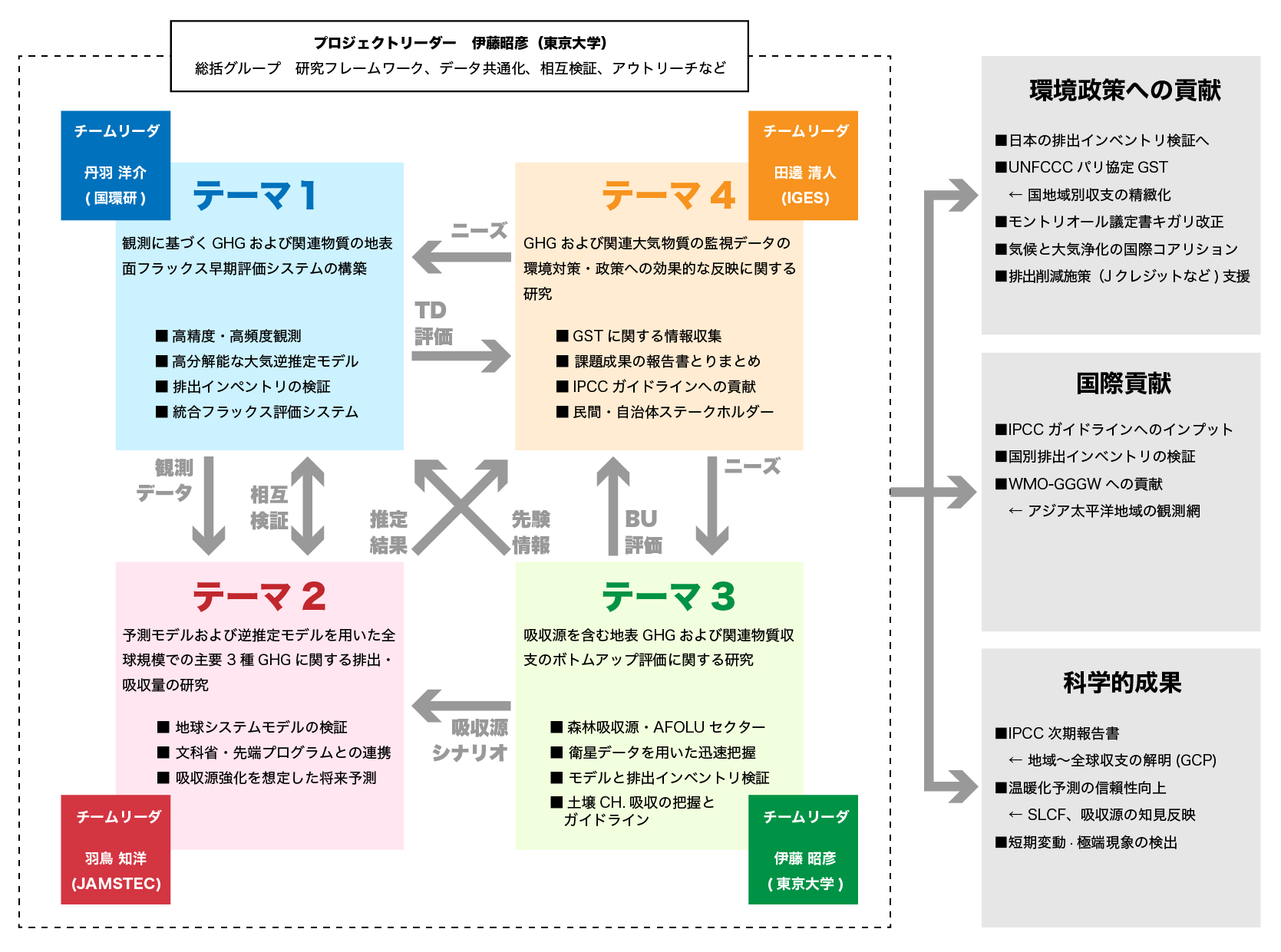
Four Research Topics
When it comes to monitoring atmospheric GHGs, many people are familiar with the continuous CO₂ concentration observations conducted at Mauna Loa, Hawaii. Indeed, the Mauna Loa data has made an unparalleled contribution by showing the changes in atmospheric CO₂ since the 1950s at a location representative of the global atmosphere. Modern atmospheric monitoring is expected to capture more types of gases with higher precision and spatiotemporal resolution. To implement more detailed climate change measures, there is now a demand to provide information not only on the total emissions and average atmospheric concentrations of as many types of GHGs and related substances (such as SLCFs) as possible for the entire world, but also detailed information down to the national, regional, and even major city levels.
S-22 is structured to meet such needs and will comprehensively advance research through the integration of observations and models, as well as collaboration between natural and social sciences. As shown in Figure 1, S-22 consists of four topics, each focusing on precise current status assessment based on observations, understanding of variation mechanisms using global models, estimation of emissions and absorption at the surface, and activities aimed at policy contributions (explained in detail in the next section). Here, we will utilize various research resources available in Japan, such as observational data from the Greenhouse Gases Observing Satellite (GOSAT) series, observation networks deployed in the Asia-Pacific region, and advanced simulation models. By conducting close collaborative research among observation, modeling, and policy-oriented research groups, we aim to respond quickly and flexibly to society's needs.
Expected Outcomes and Contributions of S-22
One of the policy contributions targeted by S-22 is the "Global Stocktake." Going back a bit, before S-22 began, a project called SII-8 was conducted with the purpose of contributing to the process of reviewing progress toward the goals set out in the Paris Agreement (Global Stocktake). The first Global Stocktake was conducted from 2021 to 2023, and a resolution document on its results was adopted at COP28 in 2023. Based on this, countries are expected to raise their emission reduction targets. It is clear that reliable scientific data is needed for this important work, and SII-8 submitted data evaluating greenhouse gas emissions and absorption by bringing together Japanese science. The second Global Stocktake will be conducted from 2026 to 2028, so S-22, in which many SII-8 members continue to participate, is expected to make further contributions there.
International activities are also progressing at a rapid pace. One of these is the "Global Greenhouse Gas Watch (G3W)" led by the World Meteorological Organization (WMO), which aims to observe atmospheric GHGs in the same way as meteorological observations and to conduct analysis and predictions related to greenhouse gases using numerical models, just like weather forecasting. Since this activity is premised on implementation with the cooperation of each country, Japan, which has one of the world's leading observation networks and model development/operation capabilities, is expected to play an even greater role through S-22.
Input to the IPCC is also important as a contribution to climate change policy. The IPCC publishes assessment reports that compile scientific knowledge on climate change, and since these serve as the most reliable source of information for climate policy (including the Global Stocktake), achieving results that are included there is of great significance. In S-22, in addition to scientific knowledge obtained through observations and models, we aim to contribute in the form of recommendations to the GHG and SLCF emission assessment methods for which the IPCC sets guidelines. Additionally, related projects such as the Global Carbon Project (GCP), integrated Land Ecosystem-Atmosphere Processes Study (iLEAPS), and International Global Atmospheric Chemistry (IGAC) are being conducted, and many S-22 members are expected to be active in such international forums.